A Survey-Based Key for Holding Two Strands Together

Holding two strands of yarn together can result in beautiful projects. Lately I’ve been drawing inspiration from the KnitPicks book, Better Together: Marled Knits Collection (there’s one for crochet too!).
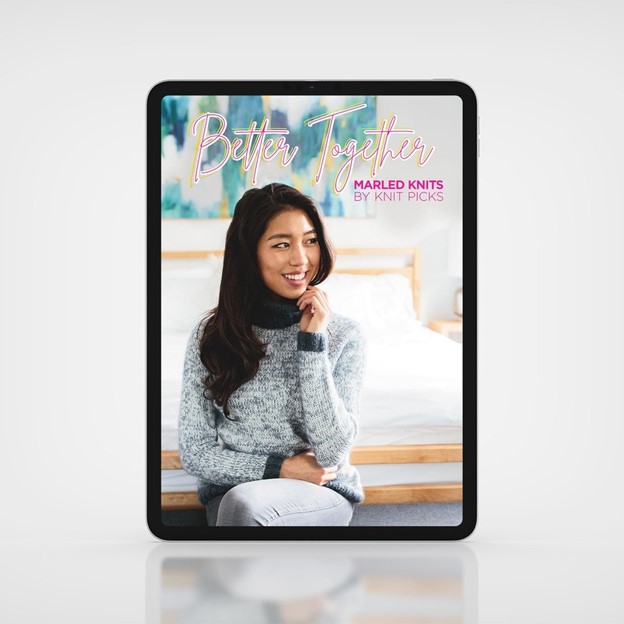
Photo © KnitPicks

In a previous post, I created a table based on collating data three yarn manufacturer’s websites. I found it helpful, but I also found it didn’t map to patterns I was using (based on pattern gauge). It also lacked needle sizing which has a huge impact on what yarn weight you end up with when it’s held double.

So, I put my scientific skills to work and did a Ravelry pattern survey and created a table that includes needle sizing and more designer detail. The methodology can be found at the end of the blog. This was much tougher than collating three sites, I had to look at every pattern doubled in every weight to collect needle sizes and confirm gauge accuracy.

As a teaser, I’m now working on a survey for three yarns held together as well as holding differing weights of yarns together (in twos and threes). Compiling this data is no small task, so please be patient!

First, a map of yarn weights collated from various knitting websites (which don’t necessarily correspond to patterns either!). This is how patterns were “mapped” to yarn weights.

GuideCommon namesSts over 4” or 10cm
Thread*Thread44+ stitches
Cobweb*Cobweb40+ stitches

Lace
Lace, light fingering33-40 stitches

Super fine
Fingering, sock, baby27-32 stitches

Fine
Sport, baby, light DK23-26 stitches

Light
DK, light worsted21-24 stitches

Medium
Worsted, Afghan, Aran16-20 stitches

Bulky
Bulky, chunky, craft, rug12-15 stitches

Super bulky
Super bulky, super chunky, roving7-11 stitches

Jumbo
Jumbo, roving6 stitches or less

* There is a lot of variation in cobweb weight. I believe this is because it isn’t considered a “standard weight, which is why there’s no “yarn skein” provided by knitting and crochet sites. The thread weight was more consistent, but there are few patterns for it.

‡ Overlap of number of stitches with other yarn weights is intentional and consistent with the original sources.

Table for Yarns Held Double

The most likely weight is shown in bold.

Single WeightDoubled WeightNeedle Sizes Range# Patterns
ThreadCobweb1-43
ThreadLace5-73
ThreadLight fingering8-105
CobwebLace2.5-818
CobwebLight fingering5-107
CobwebFingering7-105
LaceLight fingering2.5-34
LaceFingering3-510
LaceSport5-812
LaceDK7-94
Light fingeringFingering2.5-54
Light fingeringSport4-911
Light fingeringDK6-815
FingeringSport3-79
FingeringDK6-916
FingeringWorsted8-105
SportDK3-75
SportWorsted7-1010
SportAran8-10.513
SportBulky10-152
DK/Lt. WorstedWorsted3-57
DK/Lt. WorstedAran6-1017
DK/Lt. WorstedBulky10-155
DK/Lt. WorstedSuper Bulky191
WorstedAran6-812
WorstedBulky8-1115
WorstedSuper Bulky13-193
AranBulky8-10.511
AranSuper Bulky11-1713
AranJumbo19,35,506
BulkySuper Bulky11-1718
BulkyJumbo19,35,5012
Super BulkyJumbo13-19, 35, 5030

Methodology:

  • Ravelry filters were used to narrow the patterns to each yarn weight held double. Since they do not allow you to say which direction, a search for “sport” + “held double” gives you both: “sport + sport = Aran” and “fingering + fingering = sport”. I would switch from the beginning to the end pages to avoid double counting patterns.
  • 30 patterns for each weight were collated, except for thread (there were only 11 on Ravelry).
  • Some patterns claimed doubled yarn weights which do not match the listed gauge (e.g. Jumbo listed as 8 stitches over 4” maps rather to Super Bulky). For consistency, I only used patterns that provided gauge for the knitted item and mapped that to the first table.
  • Smooth (and consistently sized fuzzy) yarns only. Bouclé and other variable weight yarns were excluded.
  • Stockinette where possible for consistency—though in large weights (Super Bulky and Jumbo), garter was included to get a sufficient survey count of 30 patterns.
  • Needle weights were ranges selected from the patterns surveyed. Needle sizes that were huge on small yarns were largely excluded due to “bonkers” (a technical term) variability inconsistent from other patterns.
  • Since DK overlaps with Sport, I used the designer’s choice, rather than pattern gauge.

Substitution with Vintage or Handcrafted Yarns: How to get care, gauge, yardage and more

Many patterns specify a yarn and number of skeins, rather than yardage making substitution difficult. This post is designed to help you use vintage or any yarn on which you have little information.

I’ll be outlining ways to get yarn weight, yardage and care in order to make informed substitutions. This is especially relevant to me, since I inherited a huge stash of wool from my grandmother when she forgot how to knit when she developed Alzheimer’s.

For this blog I used a vintage yarn Zegna Barrufa Lane Borgosesia dal 1850 Peacock. This yarn is not in the Ravelry database or any other online source.

It seemed like I had a lot of this yarn. My grandmother had 17 skeins (!) in her stash. But that turned out not to be the case. They are on cardboard spools–so there is more air than yarn. I’m also dealing with three different dye lots and minor sun damage. Grandma was a penny-pincher and often bought remainders, smoke/fire damaged and sun damaged, and unlabeled yarns at bargain prices. This is only one example of many “problem children” from her stash.

Getting the Weight:

What you will need:

  • Yarns of several weights that follows the standard yarn weighting accepted today. I generally rely on Cascade Yarn for this, but any major yarn manufacturer will do.
  • Appropriately sized needles for the weights.

Methods:

Twist method: I learned this several decades ago in a class, I believe, Lily Chin taught at one of the early Stitches West. This is where you take a yarn that is a good standard for different weights of yarn.

The trick here is to have lots of “known good” weights of yarn. I have loads of leftovers that work perfect for this.

You hook the yarns around one another and then twist in opposite directions. If there is a “smooth” transition when you run your fingers across the join, you have likely found your closest yarn weight.

For the Peacock, I started with a DK, then tried a worsted, aran and bulky. What I learned was that because of the variance in the yarn, it ranges from worsted to aran and it is too big for DK and too small for bulky.

Gauge swatch: Now that we have an approximate weight. I recommend knitting a gauge swatch of the matching weight yarn and your “unknown” using the same needles. Measure and compare the swatches.

If they have the same stitches to the inch, you are done. If not, knit a swatch with the yarn that is one size up if your mystery swatch has fewer stitches or one size down if your mystery swatch had more stitches to the inch.

And keep your swatch of the unknown yarn. It will come in handy for determining the care.

Getting the Yardage:

What you will need:

  • A yarn swift (I’ve also used chair backs–anything you can measure around)
  • Flexible measuring tape
  • If the yarn is in a skein, a yarn bowl or way to hold it steady while you wind it onto a swift

Method:

  • If yarn is in a hank, place it on the swift and extend the swift to the maximum size; If yarn is a skein, wind yarn onto the swift (Steps 1 and 3 in image below)
  • Measure around the swift (Steps 2 and 4 in image below)
  • Count the number of strands (step 5)
  • Multiply the number of strands by the number of inches (e.g., 50 strands time 60 inches) and divide by 36 (inches in a yard) (not shown)

In my case, I got 50 strands at 60 inches, so that’s 3,000 inches of yarn. I divided this by 36, to get ~83.33 yards. Keep in mind, yarn is sold by weight not length, so you shouldn’t expect to get a round number. After getting the yardage, I wound it back into a skein (Step 6).

With 17 skeins I actually only have about 1400 yards total and only 833 yards of a single dye lot.

Getting the Care:

As you can see from the yarn label, it says to wash in temperature 30 (F or C?), it is possible to use an iron and it is possible to wash with most detergents, but not bleach. This still leaves a lot of missing information.

There are three (maybe more) ways to determine how to launder the fabric you create with this yarn. They are as follows:

  • Look on the label. Sometimes “superwash” or similar phrases are there. In my case the yarn came with symbols and these can be looked up online. I’ve included the reference chart below.
  • Look at yarns with similar composition. On Ravelry there are wealth of yarns which have this information. If you find one of similar percentages, you came mostly rely on this information.
  • The most foolproof way is to swatch (the same one you made for gauge) and do to it anything you might do with the finished item. Wash, it dry it, dye it, bleach it, etc.

Dealing with Multiple Dye Lots or Sun Damage:

The easiest way to deal with inconsistent dying or sun damage is to group them by color and alternate in your most different skeins, every other row. Another thing that works very well is blending it with another yarn for a marled look. If the color problem is minor, it will be invisible.

Do Try This At Home

It can be hard, these days, to get to your LYS. So, I hope this post helps you use up more of the yarn you already have. I’ll be posting an afghan I’m working where I’m blending vintage yarns in an effort to get something both useful and beautiful by using up my grandmother’s stash.